product study · client project · internal tool
CNC Quote
Order emails with DWG, DXF and PDF drawings come in. The tool checks each drawing, repairs what is safe to repair, asks about what is not, works out cutting and bending time, and produces a quote as PDF and spreadsheet. A person approves each stage.

- type
- client project
- year
- 2026
- status
- working tool, run locally
- role
- solo, research to working tool
Sneak peek
-
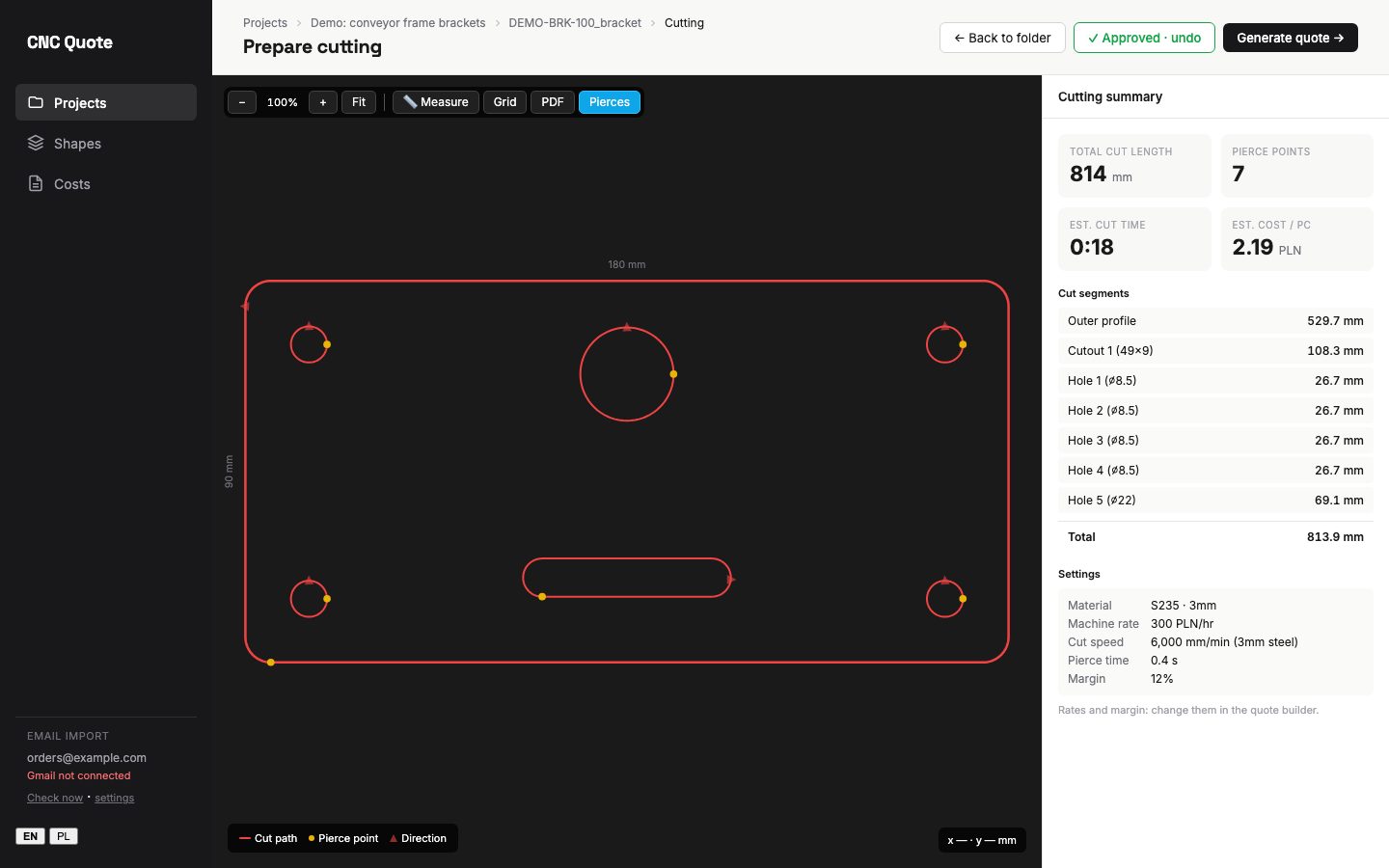
01 · Cutting canvas: cut paths, pierce points, direction, cut length and cost -
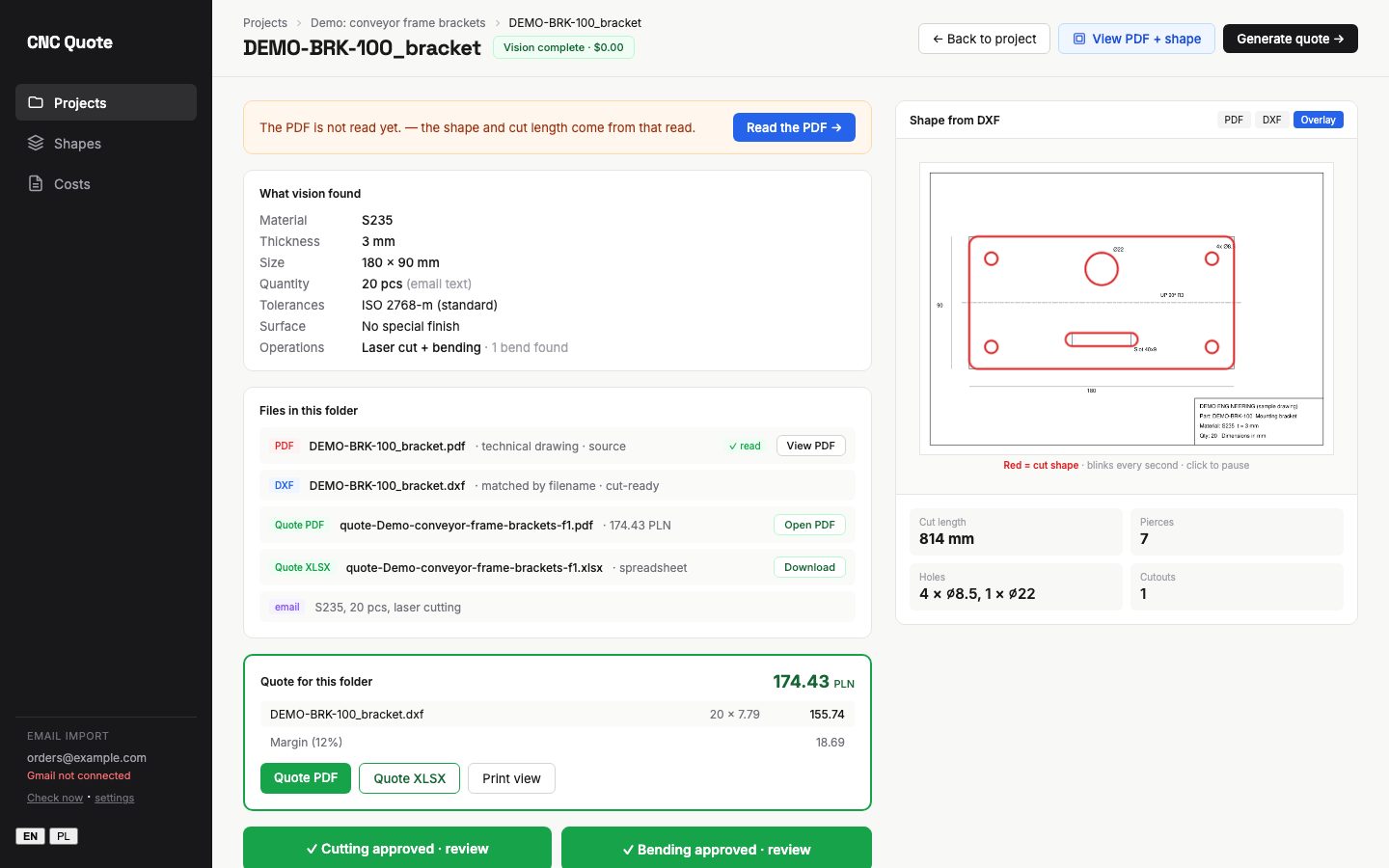
02 · Part folder: the DXF cut shape laid over the customer's PDF drawing -
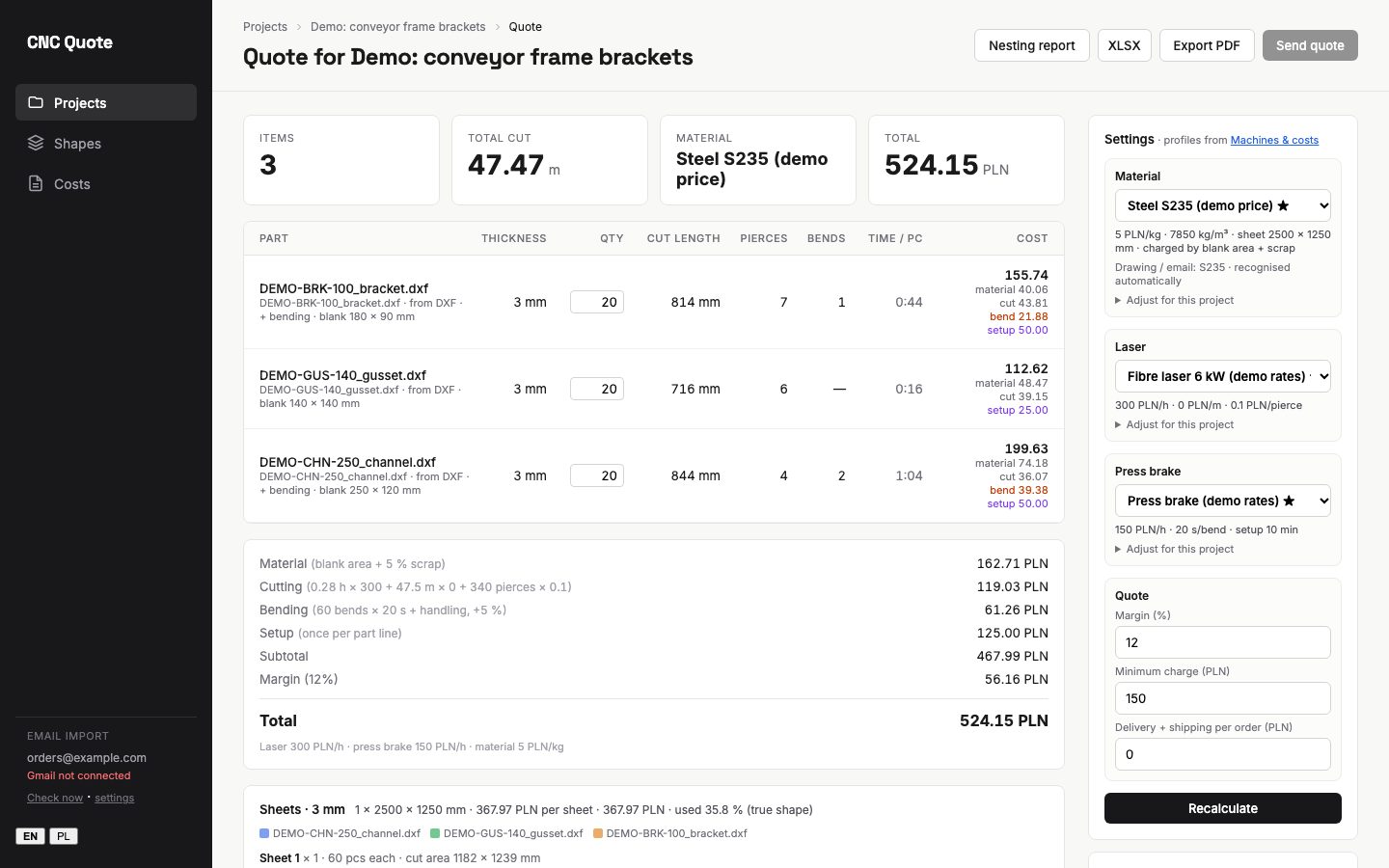
03 · Quote builder: per-part costs, material, machine profiles and margin (demo rates) -
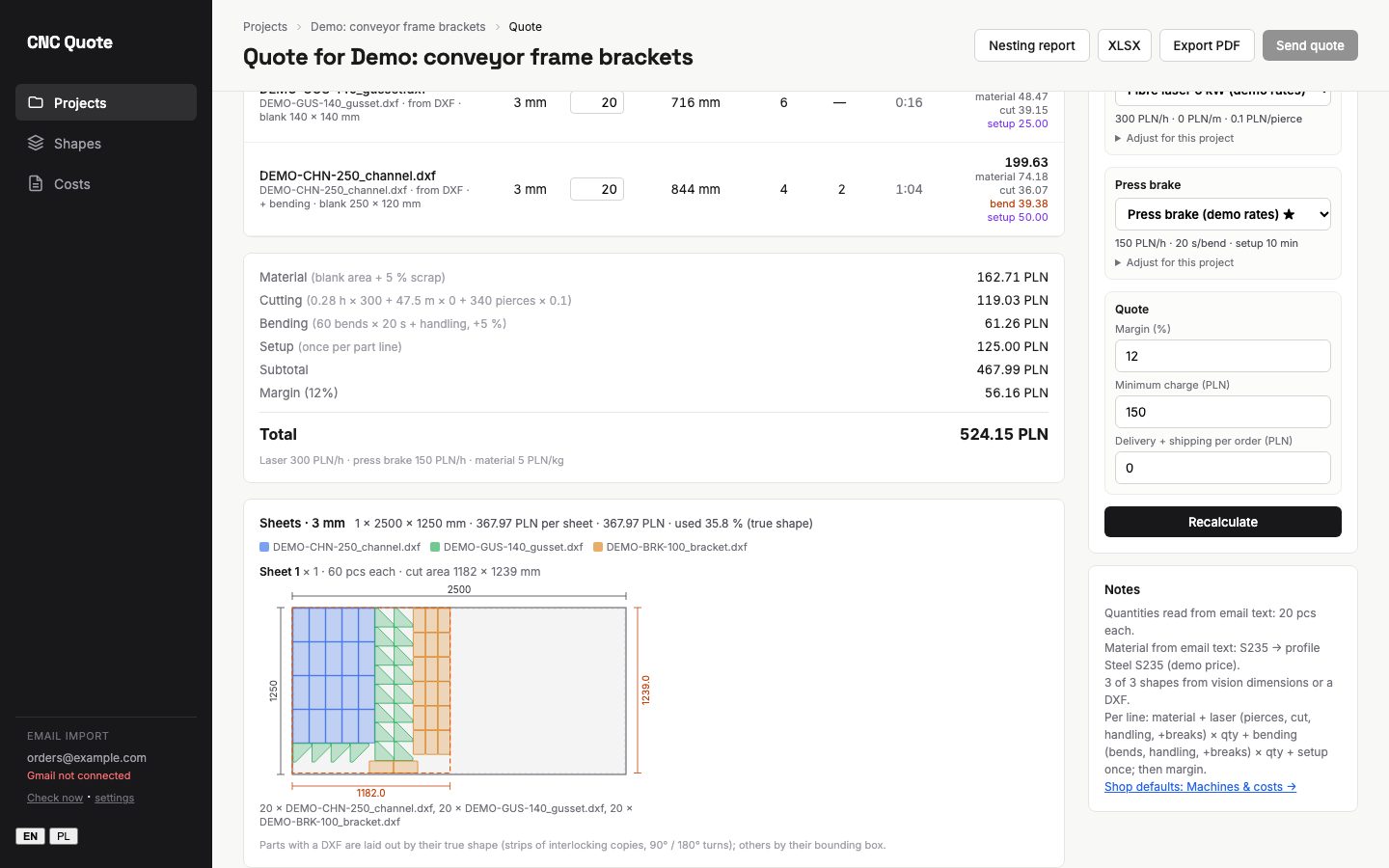
04 · Automatic nesting: parts laid out by their true shape on a sheet
The hard parts
-
01
The drawing is checked before the price
Doubled lines, centre lines, wrong units, wrong scale, open outlines and bend lines are found first. Safe fixes are applied and logged. Anything that depends on what the customer meant becomes a question with answer buttons, not a guess.
-
02
Outlines that actually close
Line ends that nearly meet are snapped together and closed loops are rebuilt from the pieces, so holes and outer edges are counted correctly. On a real bracket this found all eight holes.
-
03
PDF and CAD file compared
The PDF drawing is read with Claude vision and paired with its DXF. The DXF outline is then laid over the PDF's lines to check that the dimensions on paper match the geometry that will be cut.
-
04
Machine time from a simulated cut
The tool plans the cut path and adds up pierces, cutting speed for the material and thickness, and rapid moves between cuts. Every line of the quote names the profile setting it came from.
-
05
Checked against real quotes
Results are compared with the shop's nesting software on real jobs. Totals differ by 0 to 1.7%, and sheet utilisation by under one percentage point. The comparison runs as a test.
-
06
A model that did not earn its place
I trained a detector to find dimensions on drawings. It scored well on generated pages and badly on real ones, so the rule-based reader stayed and the model was shelved. The numbers are in the project reports.
-
07
AI only when asked
Vision calls have a spending cap and are never made just by opening a project; a test enforces that. Cutting and bending are each approved by a person.
In numbers
- ≤1.7% gap to the shop's nesting software on 5 real jobs
- 824 automated tests passing
- 28 reference drawings, each with an expected verdict
- 3 drawing formats: DWG, DXF and PDF
stack · Python · ezdxf · Shapely · NumPy · SciPy · PyMuPDF · OpenCV · Pydantic · Claude API (vision) · Gmail API · pytest · Playwright
What it
shows
AI put to work inside a real business process: measured against reality, capped in cost, and with a person approving every step.